


https://www.youtube.com/watch?v=uVlDl_457VE
Maltese Prof. Zarb Adami a Scientist to Help fund and protect satellites from Space Junk
A unique multi-pixel instrument capable of detecting space debris in orbit is being developed by Maltese scientists following a funding agreement signed between Malta and Italy.
This debris – space waste that mostly consists of discarded man-made objects such as old satellites, tools and spent-up rocket stages – numbers in the hundreds of thousands, and each piece of “junk” is capable of producing considerable damage to operational satellites.
“Those familiar with the film Gravity know all too well the havoc caused by space debris hitting the International Space Station. The instrument we’re working on is so precise that it’ll enable satellites to dodge a catastrophic crash with space litter,” astrophysicist Kristian Zarb Adami said.
The agreement signed between the Institute of Space Sciences and Astronomy at the University of Malta and the Instituto Nazionale di Astrofisica and the Agenzia Spaziale Italiana, enables ISSA scientists to complete their work.
Dr Alessio Magro and Denis Cutajar have designed a data processing system capable of detecting and tracking many pieces of space debris simultaneously. This multi-pixel detector is one of the first such systems operating in Europe and ISSA is planning to wrap up this project by the end of the year.
This system, which once completed will be placed on the Northern Cross in Bologna, has been developed to electronically track the debris without having to slew expensive radio dishes at fast speeds.
Prof. Zarb Adami, director of ISSA, said that space debris was becoming more and more challenging as countries launched more satellites for communication, navigation and earth observation.
According to NASA, more than 500,000 pieces of debris or “space junk”, are tracked as they orbit the Earth. They all travel at speeds of up to 17,500mph, fast enough for a relatively small piece of orbital debris to damage a satellite or a spacecraft.
There are no garbage collectors in space and the increasingly high level of uncollected waste orbiting the Earth increases the potential danger to all space vehicles, but especially to the International Space Station, space shuttles and other spacecraft with humans aboard.
Launching and positioning a satellite today costs roughly €1bn, so the project of the Maltese scientists is crucial to accurately track satellite-destroying junk. The ability to track and more
importantly predict the position of space junk allows for the slight modification of these satellites’ orbits to avoid deadly collisions.
The agreement will also provide opportunities for scholarships for Maltese students keen on pursuing space sciences and astronomy in the future, Prof. Zarb Adami said.
http://www.independent.com.mt/articles/2017-03-23/business-news/Maltese-scientists-funded-to-protect-satellites-from-space-junk-6736171972
What is Space Debris?
With a mysterious space object making a splash into the Earth’s atmosphere on November 13, Nasa administrator Charles Bolden has shown concern about the growing junk in the space that may threaten the planet in near future. Dubbed WT1190F, the unknown object – either a spent rocket stage, a paneling shed or a piece of debris dating back to the Apollo missions – was predicted to make a splashdown in the Indian Ocean about 100 km off the coast of Sri Lanka

But it was unclear if the object actually landed.
According to Bolden, it is the right time to clean up space crowded with all kinds of objects – from nonfunctional spacecraft, abandoned launch vehicle stages, mission-related debris and fragmentation debris, oxnews.com reported.
“Not a lot of countries are putting money into debris removal development and more of us need to,” he was quoted as saying.
Nasa has estimated roughly 500,000 pieces of space junk and there may be more than 100 million tiny fragments.
Earlier, a large space rock zipped past the Earth on Halloween on October 31 that was most likely a dead comet that fittingly bears an eerie resemblance to a skull.
Scientists observing asteroid named 2015 TB145 determined that the celestial object was more than likely a dead comet that has shed its volatiles after numerous passes around the Sun, Nasa had said in a statement.
The belated comet has also been observed by optical and radar observatories around the world, providing even more data, including our first close-up views of its surface.
Asteroid 2015 TB145 safely flew by our planet at just under 1.3 lunar distances, or about 486,000 km, on Halloween.
The next time the asteroid will be in Earth’s neighbourhood will be in September 2018, when it will make a distant pass at about 38 million km or about a quarter the distance between Earth and the sun.
Space Junk WT1190F (WTF) Hit the Atmosphere Friday the 13th
WT1190F crashed into Earth’s atmosphere early today – Friday, November 13, at about 06: 18 GMT over the southern coast of Sri Lanka – at an estimated velocity of 24,600 miles per hour or 11 km/s. Most of WT1190F reportedly burned up in the upper atmosphere and astronomers do not expect that any significant and identifiable piece of the space object would survive the plunge through the atmosphere. Measuring 3 to 6 feet, the… According to the agency, they then realized it had been spotted before, in 2013, by the Catalina Sky Survey at the University of Arizona.
Scientists have said that a mysterious piece of space debris that was said to be streaking towards Earth about a month ago swattered in the Indian Ocean on 13th October morning, said.
The organization used Friday’s innocuous space debris as a trial run of such observations to prepare for when a more unsafe space object shows up. Scientists are hoping the footage of the debris break up will provide information on how objects interact with the Earth’s atmosphere. In just this past week, in fact, three unexpected pieces of space trash have crashed down in the southeast of Spain. For the airborne research team, and observers on the ground if the weather is clear, scientists expect the falling object to produce a bright fireball that should be visible even in daytime.
With a density ten percent that of water, WT1190F is pushed around in space more easily than denser objects.
We know this because it is by no means the first human-made object to fall from orbit, nor is it the largest. It had originally been orbiting the Earth from beyond the moon, when that orbit degraded. They were flying over the thick clouds covering the Sri Lanka coast and were able to get a few pretty awesome shots of WT1190F as it came in. Most of the objects that do land end up in an ocean, since oceans make up most of the Earth’s surface.
Slooh’s broadcast will feature Slooh host Paul Cox and impact specialist Dr. Mark Boslough who will discuss the importance of WT1190F.
The ESA’s NEOCC has identified WT1190F as a valuable opportunity for scientists.
What is Space Debris?
pace debris, also known as orbital debris, space junk and space waste, is the collection of manmade defunct objects in orbit around Earth. This includes spent rocket stages, old satellites and fragments from disintegration, erosion and collisions. Since orbits overlap with new spacecraft, debris may collide with operational spacecraft.
As of 2009 about 19,000 pieces of debris larger than 5 cm (2 in) are tracked, while an estimated 300,000 pieces larger than 1 cm exist below 2,000 kilometres (1,200 mi). For comparison, the International Space Station orbits in the 300–400 kilometres (190–250 mi) range and the 2009 satellite collision and 2007 antisat test events occurred at from 800 to 900 kilometres (500 to 560 mi).
Most space debris is smaller than 1 cm (0.4 in), including dust from solid rocket motors, surface-degradation products (such as paint flakes) and frozen coolant droplets released from RORSAT nuclear-powered satellites. Impacts by these particles cause erosive damage, similar to sandblasting, which can be reduced by the addition of ballistic shielding (such as a Whipple shield, used to protect parts of the International Space Station) to a spacecraft. Not all parts of a spacecraft can be protected in this manner; solar panels and optical devices such as telescopes or star trackers are subject to constant wear from debris and micrometeoroids. Below 2,000 kilometres (1,200 mi), the flux from space debris is greater than that from meteoroids.Decreasing risk from space debris larger than 10 cm (4 in) is often obtained by maneuvering a spacecraft to avoid a collision. If a collision occurs, the resulting fragments can become an additional collision risk.
Since the chance of collision is influenced by the number of objects in space, there is a critical density where the creation of new debris is theorized to occur faster than natural forces remove them. Beyond this point a runaway chain reaction (known as the Kessler syndrome) may occur, rapidly increasing the amount of debris in orbit and the risk to operational satellites. Whether the critical density has been reached in certain orbital bands is a subject of debate. A Kessler syndrome would render a portion of useful polar-orbiting bands difficult to use, increasing the cost of space missions. The measurement, growth mitigation and potential removal of space debris are conducted by the space industry.
Debris growth
During the 1980s, NASA and other U.S. groups attempted to limit the growth of debris. One effective solution was implemented by McDonnell Douglas on the Delta booster, by having the booster move away from its payload and vent any propellant remaining in its tanks. This eliminated the pressure buildup in the tanks which caused them to explode in the past. Other countries were slower to adopt this measure and, due especially to a number of launches by the Soviet Union, the problem grew throughout the decade.
A new battery of studies followed as NASA, NORAD and others attempted to better understand the orbital environment, with each adjusting the number of pieces of debris in the critical-mass zone upward. Although in 1981 (when Schefter’s article was published) the number of objects was estimated at 5,000, new detectors in the Ground-based Electro-Optical Deep Space Surveillance system found new objects. By the late 1990s, it was thought that most of the 28,000 launched objects had already decayed and about 8,500 remained in orbit.By 2005 this was adjusted upward to 13,000 objects, and a 2006 study increased the number to 19,000 as a result of an ASAT test and a satellite collision. In 2011, NASA said that 22,000 objects were being tracked.
The growth in the number of objects as a result of the late-1990s studies sparked debate in the space community on the nature of the problem and the earlier dire warnings. According to Kessler’s 1991 derivation and 2001 updates, the LEO environment in the 1,000 km (620 mi) altitude range should be cascading. However, only one major incident has occurred: the 2009 satellite collision between Iridium 33 and Cosmos 2251. The lack of obvious short-term cascading has led to speculation that the original estimates overstated the problem.According to Kessler a cascade would not be obvious until it was well advanced, which might take years.
A 2006 NASA model suggested that if no new launches took place the environment would retain the then-known population until about 2055, when it would increase on its own. Richard Crowther of Britain’s Defence Evaluation and Research Agency said in 2002 that he believed the cascade would begin about 2015. The National Academy of Sciences, summarizing the professional view, noted widespread agreement that two bands of LEO space—900 to 1,000 km (620 mi) and 1,500 km (930 mi)—were already past critical density.
In the 2009 European Air and Space Conference, University of Southampton researcher Hugh Lewis predicted that the threat from space debris would rise 50 percent in the next decade and quadruple in the next 50 years. As of 2009, more than 13,000 close calls were tracked weekly.
A 2011 report by the U.S. National Research Council warned NASA that the amount of orbiting space debris was at a critical level. According to some computer models, the amount of space debris “has reached a tipping point, with enough currently in orbit to continually collide and create even more debris, raising the risk of spacecraft failures”. The report called for international regulations limiting debris and research of disposal methods.
Space Junk Alert
https://www.youtube.com/watch?v=vx9200JmG3Y
As we’ve written here before, future wars could well be fought in space. The US Air Force is now looking for ways to protect crucial American interests in space.
The USAF is working on a project to build a so-called space fence that will be detect threats and protect American satellites from debris and other space faring powers that might want to harm them.
The fence in this case is no fence at all, but an advanced radar system that will be able to track objects in space the size of a baseball ball.
The Dangers of Space Junk
Space debris, also known as “space junk,” is the collection of natural and manmade objects that orbit Earth. These objects range in size from tiny meteoroids to fragments from nonoperational satellites and spacecraft that are left to deteriorate in space. Scientists have tracked down more than 500,000 pieces of space junk that can threaten the safety of all space vehicles.

Space junk, traveling at speeds up to 20,000 miles per hour, can pose a severe threat to satellite or spacecraft. High-speed collisions from even the smallest pieces of space junk can threaten the lives of astronauts and cause serious damage to the International Space Station and other orbiting spacecraft.
Fortunately for astronauts, most space junk is located between 500 to 700 miles above Earth. Today, our manned spacecraft are between 200 to 300 miles above Earth. Even though space programs today are being designed to limit the amount of debris that can be sent into space during a launch, the amount of space junk has been increasing. With many objects flying near Earth, the resulting collisions between those objects can create even more fragments in space.
Even if we stopped launching rockets or spacecraft, the amount of space junk would remain constant for many years. The higher the altitude an object is from Earth, the longer it will take to fall to Earth’s surface due to gravity. Even then, there are fears that the material already in orbit will inevitably collide, creating even more space junk.
NASA and the Department of Defense are working together to monitor space junk. They maintain a highly accurate satellite catalog and establish ongoing guidelines for assessing the threat of collisions between space junk and spacecraft. Depending on the threat, evasive action can be taken or other safety precautions can help protect spacecraft and the people on board.
By Bryan Demapan, intern, Buhl Planetarium
Israeli Space Junk
An Israeli satellite that provides telecoms and TV service to much of Africa, Amos-5, has mysteriously disappeared from Earth’s orbit, sparking fears that it was struck by space debris rendering it space junk itself.
The company that produced the satellite, Spacecom, has been frantically attempting to re-connect with the satellite after it stopped responding on 21 November with no explanation as to why it stopped, with all systems appearing to be functioning normally prior to its disappearance.
According to Space News, the company has said as of 23 November that it is tracking the satellite’s orbit but has been unable to contact it with “no information on the nature of the incident” and a genuine possibility that it could be silenced forever.
The last incident that threatened the function of the satellite occurred back in 2013 when its battery charger malfunctioned, which was eventually solved, but Spacecom has said that this is not the issue affecting it this time.
With little-to-no indication or method of getting it back online, a considerable amount of TV and telecoms providers in Africa, as well as some parts of Europe and the Middle East, are being left in darkness, with Spacecom now attempting to redistribute the capacity to other satellites.
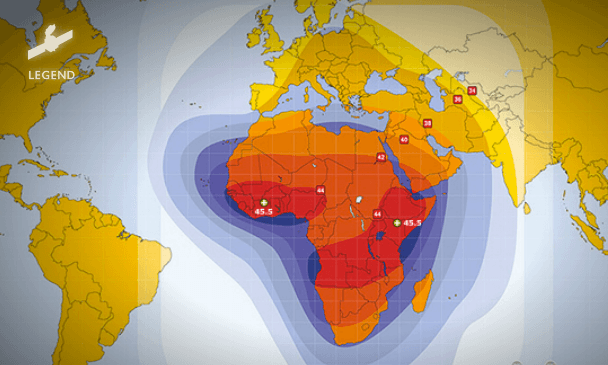
Prior to its silencing, Amos-5 was working at 65pc load capacity, which, given the amount of data being processed, is a considerable amount to redistribute to the three other satellites operated by the company.
In its statement, the company said: “There are several options for transferring customers and we are closely working with customers vis-a-vis other satellite operators to ensure minimal interruption. Spacecom is being completely transparent with our clients. We are working to find solutions for each and every client.”
The satellite has been in orbit since 2011, having been constructed by the Russian manufacturer ISS Reshetnev, marking one of the few commercial space projects between Russia and other nations.
Meanwhile, it could prove disastrous for Spacecom financially as Amos-5 is believed to be contributing up to one-third of the company’s entire revenues, resulting in a one-third decline its share price.
However, Spacecom has reassured investors that the satellite is insured up to the value of $158m leaving a “negligible” effect in the long-term.
As for what caused the satellite to go dark, it could easily be assumed that the ever-growing concerns over space debris hitting the satellite, brought on by Earth’s orbit becoming clogged with defunct satellites, could be a likely candidate.
Updated 07:51 24/11/2015
This article was amended to show that Spacecom currently have three other satellites in space, rather than four.
Space Waste Falling From Skies Over Florida

The space debris that is expected to crash into earth on Friday

A”Fishing Ban” and a “No-Fly-Zone” have been imposed in the Southern sea area and over the sky as a space debris named WTF1190F is expected to enter the Earth’s atmosphere on November 13
Details of the no-fly zone and fishing ban were posted on the website of the Ministry of Defence.
The space debris that is expected to crash into earth on Friday was named WTF1190F by astronomers If WTF1190F is a piece of rocket, it will be the first piece of man-made junk to return home independently.
WTF1190F, is set to land in the Indian Ocean, around 40 miles, that is around 65 kilo metres off the southern tip of Sri Lanka, at 11:50 a.m. on November 13.
Physical Sciences Division at Colombo University, Professor Chandana Jayaratne stated:
Based on the trajectory we can assume that this object might explode or burn in the atmosphere. If this a piece of rocket, then we cannot be certain that it would burn completely, and if it explodes in the atmosphere it may rip into several pieces.
He also stated:
It may also crash on the ground. However, the risk of that happening is very low and there is no reason for us to panic because objects larger than this have crashed on to earth before
Minister of Fisheries and Aquatic Resources, Mahinda Amaraweera speaking on the issue stated:
I have instructed my staff to inquire into this situation and we have the technology to pass the message within a matter of hours. Therefore, we do not have any issue
The Disaster Management Centre’s Assistant Director Pradeep Kodippili says that all relevant authorities have been informed of this matter and that they are monitoring the situation.
Professor Chandana Jayaratne speaking on the issue stated:
We can witness this through the naked eye and the path of this debris will be in the direction of the sun to the Southwest. At times it might be difficult to see, but you might be able to see something like a fireball.
http://newsfirst.lk/english/2015/11/space-debris-entry-to-earth-fishing-ban-and-no-fly-zone-imposed/117505
Bagpipes to become ‘space junk’ in 17,500mph orbit
THE Scots-made pipes, on which astronaut Kjell Lindgren played Amazing Grace, will be jettisoned from the international space station because its capacity is limited.

THE first bagpipes to be played in space are to join other “space junk” in 17,500mph orbit.
The Scots-made pipes, on which astronaut Kjell Lindgren played Amazing Grace, will be jettisoned from the international space station because its capacity is limited.
Lindgren, 42, played in tribute to his scientist and instructor colleague Victor Hurst, who died last month aged 48.
He had ordered the £450 plastic pipes from McCallum’s of Kilmarnock in the hope of performing in orbit.
Kenny Macleod, of McCallum’s, said: “Kjell asked for the lightest pipes that could be packed away into the smallest space.
“And he said at the outset said there was a fair chance that the pipes would be ejected because of the issues involved in space and storage.
“They’ll probably just put them into space.
“Who knows, 100 from now, somebody might find them. I’d be confident they would play OK.
Like all space debris over 5cm in size, the pipes will be monitored by NASA. The agency said: “There are more than 20,000 pieces of debris larger than a softball orbiting the Earth.
“They travel at up to 17,500mph, fast enough for a relatively small piece of debris to damage a satellite or a spacecraft.
“There are 500,000 pieces of debris the size of a marble or larger.”
http://www.dailyrecord.co.uk/news/weird-news/first-bagpipes-played-space-join-6800103
European Space Agency Needs The Space Waste Transporter

When the European Space Agency’s Sentinel-2B satellite joins its 2A twin in orbit next year, the project’s volume of data in the form of images of the Earth’s surface will soar to up to two petabytes annually.
To cope with that data growth, ESA has just expanded the 2013 contract it awarded Spanish company Indra to take it up to 2020 and to include data management for the twin satellites.
Robust long-term global records of essential climate variables, such as warehouse gas concentrations, sea-ice extent and thickness, and sea-surface temperature and salinity, are crucial to understanding and mitigating the consequences of climate change.
Europe’s eyes in space focused on Earth are provided by the Copernicus program, headed by the European Commission in partnership with ESA, which coordinates the delivery of data from upwards of 30 satellites. Among them are the Sentinels, which provide a unique set of observations that need to be processed and archived.
ESA’s initial 2013 contract with Indra used the company’s facilities at San Fernando de Henares, 15km from Madrid, as one of the main data-processing and archiving centers, or PACs, for the Sentinel-2A satellite mission’s ground segment.

When both satellites are in operation, the Sentinel-2 mission will be capable of obtaining complete coverage of the Earth’s land surface every five days — or 10 days when only one satellite is in operation — with a spatial resolution of up to 10 meters. The information supplied by these images will be especially useful in the fields of agriculture and environmental management.
According to Rosana Romero, head of Sentinel PAC project at Indra, the company’s experience in missions such as Helios, SMOS, and Ingenio, and in providing similar services to other clients, as well as the various projects funded by ESA Earth Observation department, have had a significant bearing on ESA’s decision to award it the expanded contract.
http://www.zdnet.com/article/europes-eyes-in-space-how-esas-sentinel-2-satellite-scans-pose-petabyte-challenge/